
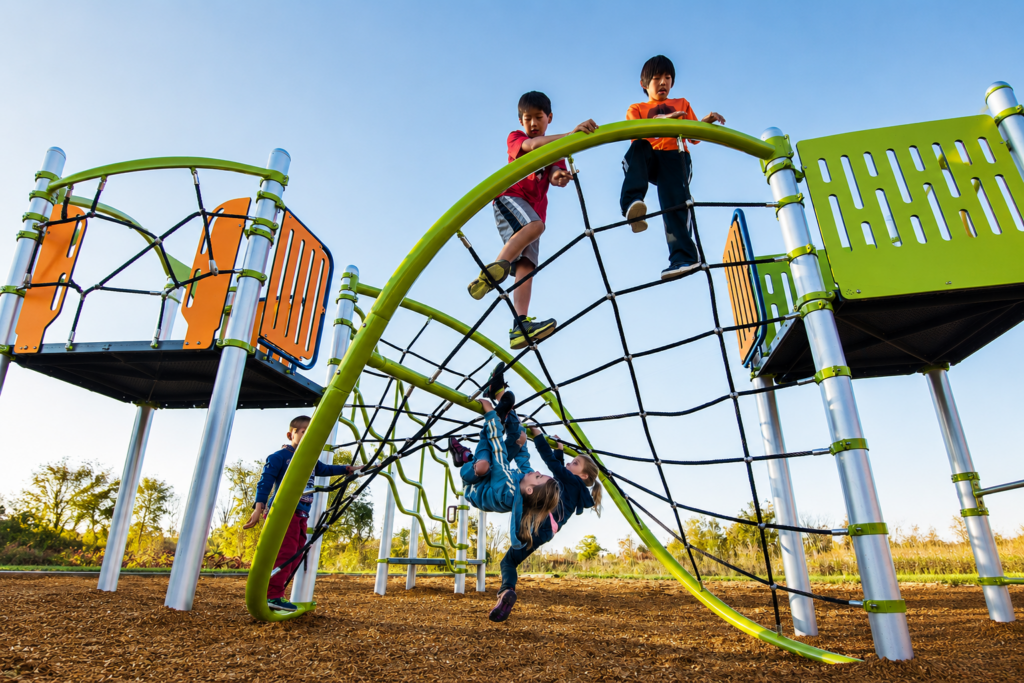
Families are starting to shift how they think about outdoor play, and no, it’s not to add more padding to the playground. In fact, it’s the opposite. After years of highly sanitized playground designs, parents and designers alike are recognizing that kids need more than a flat surface and a slide. Climbing, hanging, and physically demanding activities are trending, and for a good reason.
Why kids are wired to climb
The desire to climb is deeply wired into children. Watch a toddler near a couch arm, a low wall, or a pile of rocks, and the instinct kicks in almost immediately. It’s not recklessness, it’s development.
Climbing challenges kids to assess risk, problem solve, and push their physical limits in a way that tamer play simply doesn’t offer. Every time a child figures out how to get from one rung to the next, they’re making dozens of small calculations about grip, weight, distance, and effort. Research increasingly supports the idea that play involving a manageable degree of challenge builds the kind of resilience, confidence, and coordination that lasts well into adulthood.
Why monkey bars are having a moment
This is part of why monkey bars for your backyard are having such a moment right now. They hit a sweet spot that few other pieces of equipment can match. The upper body strength required to traverse a bar set develops grip, shoulder stability, and core control in a way that’s hard to replicate with other backyard gear. The focus needed to plan each move sharpens spatial awareness and concentration.
And, the satisfaction of reaching the end, especially the first time, delivers a genuine confidence boost that kids carry well beyond the backyard. It’s also the kind of equipment that gets harder to resist as kids get stronger, so the challenge grows with them rather than fading.
The nostalgia factor
The return to climbing play is also being driven by a nostalgia that many parents feel quite strongly. Growing up near creeks, construction sites, or farmland meant the environment itself was the playground.
Logs, boulders, rope swings, and uneven surfaces were just part of daily life outdoors, and navigating them built a kind of physical confidence that structured play equipment rarely matched. Modern backyard design is trying to recreate some of that texture and unpredictability in a setting that’s still safe and supervised.
The goal isn’t to recreate a building site in the backyard, but to give kids something that genuinely challenges them rather than just occupying them.
How modern climbing structures have evolved
Contemporary climbing structures have come a long way from the metal frames of decades past. Cable net designs, prefabricated boulders, freestanding sculptural frames, and caged upper platforms give kids a sense of height and challenge while mitigating fall risks through smart engineering and appropriate surfacing below.
Materials have improved significantly, too, with powder-coated steel, UV-resistant finishes, and treated timber all extending the lifespan of outdoor structures considerably. The design goal isn’t to remove the sense of danger entirely but to make the risk calculated rather than careless, which is a meaningful distinction when it comes to child development.
Matching equipment to the child
For families weighing up equipment options, it helps to think about what kind of mover each child is. Some kids are climbers from the moment they can walk. Others need a gentler entry point before they build confidence for bigger structures.
Starting with something like a low climbing wall or a simple horizontal bar set, then expanding as confidence grows, is a practical approach that meets kids where they are rather than overwhelming them early. It also means the backyard evolves alongside them, which keeps the space feeling relevant and challenging rather than something they’ve outgrown.
Inclusive design matters
Structures that offer multiple ways to engage, different heights, varied grip options, and side-by-side challenges mean kids of different abilities can all find their level within the same piece of equipment.
That matters both for families with diverse needs and for the broader social dynamics of kids playing together. When every child can participate in some way, the play that happens around the equipment tends to be richer and more connected.
Where to find quality climbing equipment
If the goal is giving kids something that genuinely challenges them and holds up over time, it pays to invest in equipment built to last. Vuly Play’s monkey bars for your backyard come in a range of sizes and configurations, designed to grow with kids as their strength and confidence develop. With options that suit different yard sizes and age groups, it’s worth taking a look at the full range before making a decision.
Final thoughts
The comeback of climbing and hanging play isn’t a trend. It’s a correction. Kids have always needed physical challenge and a sense of adventure outdoors, and backyards that provide that tend to be the ones that actually get used. Getting the right equipment in place is one of the most straightforward ways to make that happen.