
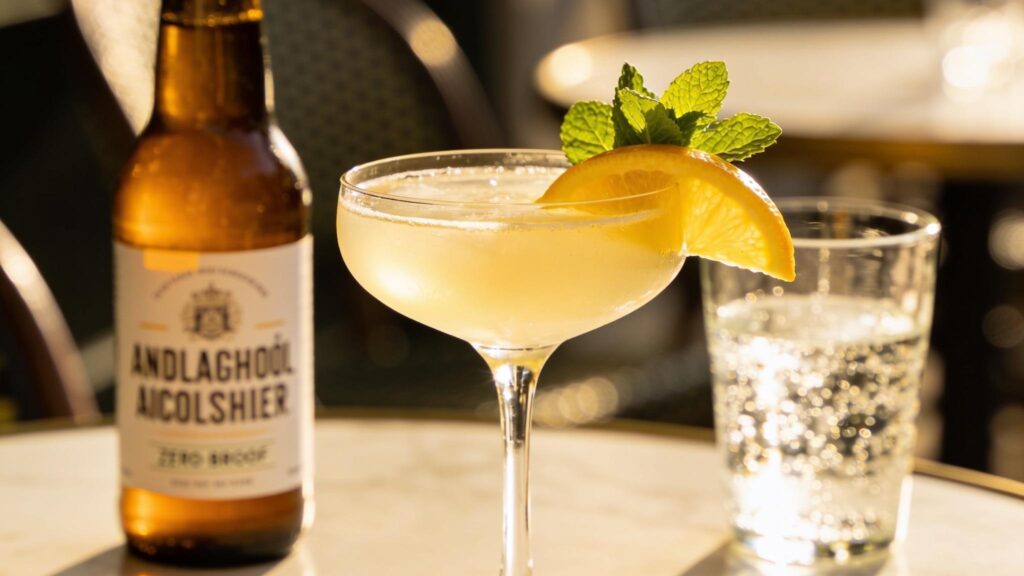
Not long ago, ordering a non-alcoholic beer at a bar took a small leap of faith. You got whatever bottle was hiding at the back of the shelf, and everyone at the table got to weigh in. These days the menus are longer than the small talk. The shift has a name, sober curious, and it is less about quitting drinking than about getting curious about it. Instead of asking whether to stop, more people are asking a smaller question: what am I getting from this drink, and do I still want it?
What “Sober Curious” Actually Means
The phrase took off after Ruby Warrington’s 2018 book of the same name, and the idea is as light as the label suggests. Sober curious does not require a crisis, a diagnosis, or an announcement. It means paying attention to when you drink, why you drink, and how the morning after feels, then letting that change what you do next.
Think of it as an experiment you run on yourself. You might take a month off and see what shifts. You might swap every second drink for a zero-proof version. You might keep Friday nights exactly as they are and skip drinking on the other six days. All of those count, and none of them require a ceremony or a label you have to keep.
That range is the whole point. On one side sits the old story that drinking is a fixed part of your personality. On the other sits the story that change only starts at a dramatic low point. Sober curious borrows from neither. It frames your relationship with alcohol as something you can adjust in small steps, and the door stays open in both directions.
People who try it describe the same small translation: the drink moves from default to decision. That sounds minor. It changes a surprising amount of an evening.
Why Mindful Drinking Is Taking Off Now
The numbers make it hard to miss. In Gallup’s July 2026 survey, 54% of U.S. adults said they drink alcohol, the second straight year at the lowest level Gallup has recorded since it began asking in 1939. Just 17% said they have swapped a non-alcoholic drink in for an alcoholic one. And 51% now see one or two drinks a day as bad for your health, up from 27% in 2001. Public opinion does not usually move that far that fast.
Part of it is support. Moderation-first tools and communities now occupy a distinct middle ground, and Sunnyside is one of the platforms built around it, aimed at drinking less rather than all or nothing. That middle ground did not always exist: for years, help with drinking meant rehab or nothing, which fit nobody who simply wanted to cut back.
Part of it is opportunity. Bars and restaurants that once offered a single sad lime soda now keep a real zero-proof list, and grocery shelves gave non-alcoholic options a category of their own instead of a lonely corner. The old choice between drinking and sitting out the evening has become a spectrum, and the middle of that spectrum is where much of the growth is. The same drift toward well-being and sustainability runs through modern life, and this look at current lifestyle trends traces it well beyond the bar.
What It Looks Like in Real Life
Most of it happens quietly, and it looks more like a few small habits than a lifestyle overhaul.
- If beer is your ritual, the non-alcoholic shelf did the heavy lifting for you: what was once an afterthought is now a full lineup, and this guide to non-alcoholic beers and the leading brands covers the best of what is on it.
- If wine marks the end of the day, dealcoholized versions and good sparkling alternatives keep the ritual intact. Use the same glasses; the pause matters more than the pour.
- If the cocktail is the fun part, a zero-proof spirit and a quality tonic get you most of the way, and a real garnish does the rest.
The social side needs a phrase, not a speech. “I am taking a month off” is a complete sentence. So is “not tonight, thanks.” If you want fewer follow-up questions, arrive with something in your hand and order first; a full glass answers most questions before anyone asks.
And if you are the host, make the easy choice the normal one. Stock two or three good non-alcoholic options next to everything else, put them at eye level, and skip the labels. When the zero-proof bottle is as accessible as the ice, nobody has to make a point of it, including you.
When “Less” Needs More Support
For plenty of people, this stays exactly as light as it sounds: a few swaps, a clear phrase or two, and a habit rewired without much drama. If you have tried that and it keeps sliding, though, take it seriously rather than personally. Drinking more often than you mean to is common, and it is not a character flaw.
Support for drinking less has widened, too. Coaches, apps, and structured programs can add accountability, and if cutting back still feels out of reach, a conversation with a doctor or clinician can widen the options, including medical support like naltrexone. That conversation is easier to start than it sounds, because you set the pace: bring how often you drink, when it feels automatic, and what you would like to change, and let the professional meet you there. There is no single right way in, whether it turns out to be an app, a coach, or a clinician’s office. It is a talk worth having before you decide anything, not after.
And none of this cancels the light version. Plenty of people cut back on their own with a one-month reset, a tracking app, and a friend who checks in, and that remains a complete plan. Extra support is simply there for the weeks when the lighter approach stalls, and reaching for it early is an ordinary move rather than a dramatic one. If you have ever changed a diet, a budget, or a gym routine, you already know the pattern: outside eyes help most when motivation dips.
One safety note, and it matters: if you drink heavily, or have for a long time, make big changes with a provider’s input rather than overnight, because stopping suddenly can be risky. That applies to cutbacks that sound small as much as to big ones. Building the plan together is not an overreaction; it is the common-sense way to start, and it keeps the change livable, which is the only kind that lasts.
One Small Question
Step back from the data and the bar menus, and the sober-curious shift comes down to a permission slip. You are allowed to want less without wanting none, and you are allowed to try that idea in public without owing anyone an explanation. There is no scoreboard, and there is no finish line. Perhaps that is why the idea keeps catching on: it puts a name to something a lot of people already suspected, and hands them the language to test it in their own kitchen. The best evenings, it turns out, were never really about what was in the glass.